Google Scholar Labs: A New Era of Academic Search?
I’ve always had a soft spot for Google Scholar.
Some academics dismiss it for its messy metadata or occasional ghost citations, but when used properly — especially with Advanced Search and Scholar Metrics — it remains one of the most powerful free tools available.
And now Google has quietly slipped something new under the tree.
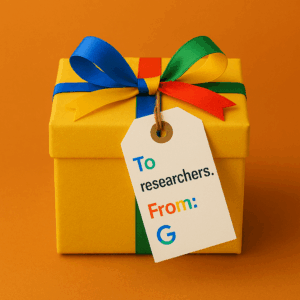
A neatly wrapped package.
A playful new button.
A gift tag that could read:
“To researchers. From: G.”
🔔 A surprise arrival
On 18 November 2025, Google officially announced Scholar Labs, an experimental AI-powered search now being rolled out slowly to a limited number of logged-in users.
If you’re one of the early testers, you’ll see this new banner when visiting scholar.google.com:
New! Scholar Labs: An AI Powered Scholar Search
A new way to search – Try Scholar Labs
And yes — it’s beautiful.
🔍 What Scholar Labs actually does
Instead of keyword strings or Boolean operators, Scholar Labs lets you ask natural-language research questions, such as:
“What are the experiences and emotions of mature professionals returning to postgraduate study years later?”
It then:
- analyses your question
- identifies its key topics and relationships
- searches the entire Scholar index
- finds papers that best address your question
- and provides short, human-like explanations of how each study contributes
All while keeping the classic Scholar tools:
Save | Cite | Related Articles | Versions
📝 How Scholar Labs differs from literature search tools like Elicit & SciSpace
Crucially:
❌ It does not synthesise the literature
❌ It does not write paragraphs
❌ It does not produce conceptual summaries
And that’s a good thing.
Scholar Labs stays safely within the zone of search, summarise, and evaluate.
For students and universities concerned about AI plagiarism, this may be one of Scholar Labs’ biggest advantages.
It’s the “middle child” between:
- Google Scholar Advanced Search (raw, powerful, & dense)
- Elicit, SciSpace, & others (AI interpreters that synthesise themes)
Scholar Labs sits somewhere in between:
a more intuitive Scholar, without the risk of write-my-assignment AI text.
BUT ALWAYS REMEMBER TO CHECK EVERY SOURCE!
🧪 My experiment
I tested the same natural-language question across:
- Scholar Labs
- Elicit (free version)
- SciSpace (free version)
Then, I compared the 10 most relevant papers selected by each tool.
The result?
Three tools → three different sets of 10 papers.
(Elicit and SciSpace shared one; Scholar Labs overlapped with neither.)
This isn’t a flaw.
Each tool indexes differently, ranks differently, and surfaces its own corner of the research landscape.
The encouraging part?
Across all three tools, the themes converged:
- identity work
- emotional intensity
- belonging and non-belonging
- work–study–family balance
- coping and motivation
- mid-career transitions
- support structures
Different papers, same story.
And again, whichever tool you use, check your sources!
🎁 What’s still in the box?
Scholar Labs is only partially unwrapped.
Maybe future versions will integrate Advanced Search, Metrics, custom filters, or more detailed summaries.
If this is just the beginning, the future could be exciting.
For now, it offers a friendlier, more natural, more human way to explore academic literature than before.
An early end-of-year or Christmas gift. 🎁
✉️ Need help with your dissertation?
I help postgraduate students from conceptualisation to completion, including literature strategy, research design, and statistical analysis.
Contact me at [email protected].
#GoogleScholar #ScholarLabs #ResearchTools #PhDLife #MastersStudents